A home care answering service picks up the calls your office can’t get to. It takes a message and passes it on, which is a real help when the phone gets busy. Some calls need more than a message, though. A family asks about care tonight, a caregiver calls off at 6 am, or a visit won’t clock in. Each one needs someone who can act on it. Here’s what an answering service covers, what it leaves for your office, and how to tell what you need.
What a home care answering service does
Home care answering service: an outside team that answers your agency’s phone when your office can’t. It takes messages and sends urgent calls to your on-call person, using a script you write.
Most plans cover the same things. They answer the calls your team can’t get to during the day, plus calls after hours and on weekends. They send the messages to whoever you choose, and some also fill out a short intake form for new families.
What they usually can’t do is work inside your agency. The operator can’t open your scheduling software or see which caregivers are free on Thursday afternoon. They also don’t know which client always gets the same caregiver. So a home care answering service takes the message well, and the decision still waits for your office.
At many answering services, the same operators take calls for many businesses. The person who answers your line tonight may not be the one from last night. They may not know your clients by name, either.
What still lands on your office the next morning
Here’s one normal night with a home care answering service, as the office finds it at 8 am.
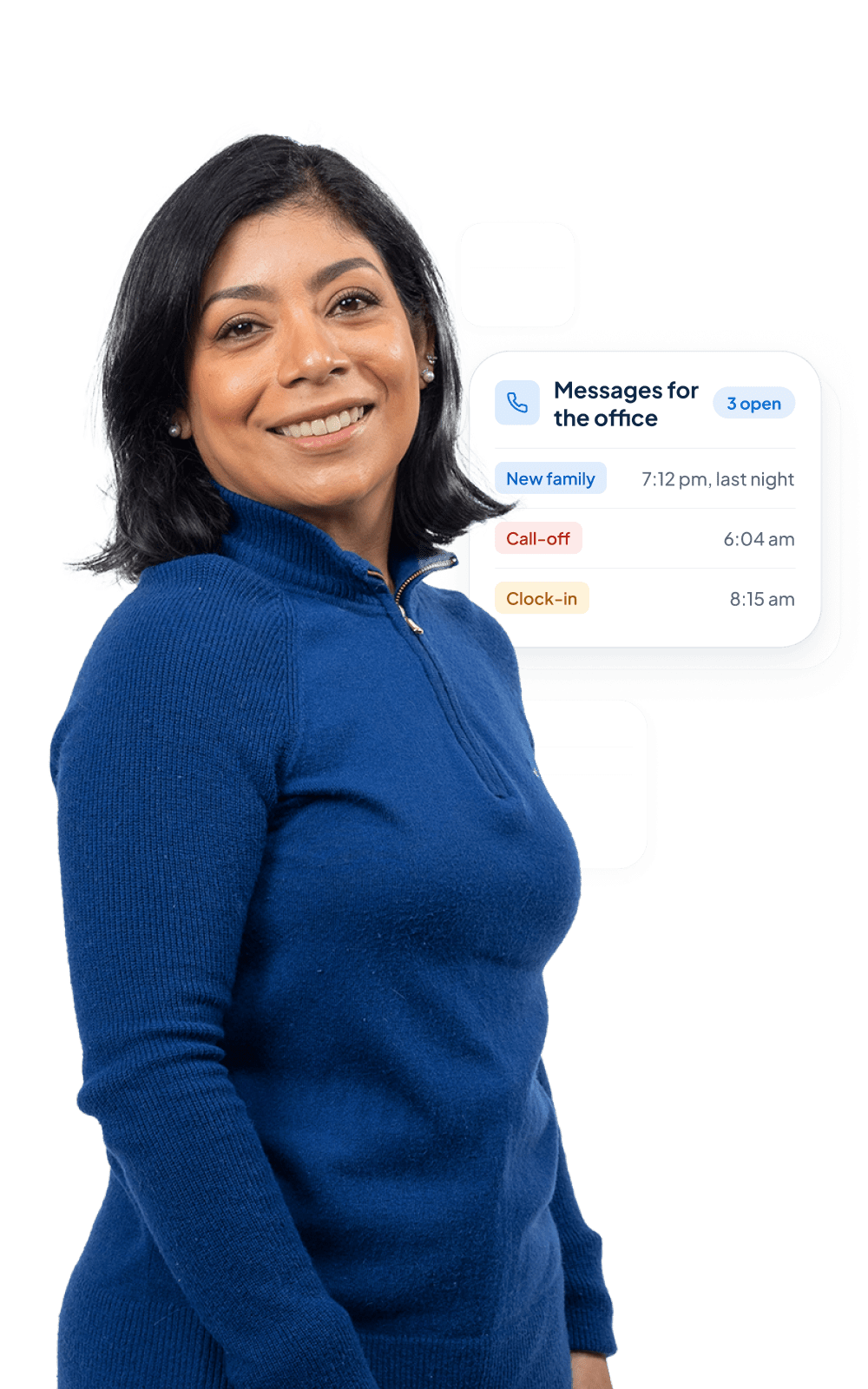
One night of messages, and the work each one still needs
- 7:12 pmA daughter calls about care for her mom. The service takes her name and number. Still open: the intake questions and booking an assessment.
- 6:04 amA caregiver texts that she can’t make her 8 am shift. The on-call phone gets the message. Still open: finding a backup and calling the client.
- 8:15 amThe office is busy with the night’s messages, so a caregiver’s call goes to the answering service. Her app won’t clock her in at the client’s door. Still open: fixing the visit record today.
Every message is correct. Each one still needs someone who can open the schedule, call a caregiver, or book a visit. The message is only where that work starts.
The three calls that decide a client or a shift
The family asking about care
A daughter calls at 7:12 pm about care for her mom. To turn that call into a client, someone has to learn:
- who the care is for
- what help her mom needs
- when care should start
- how it will be paid
Then they book the in-home assessment, ideally before she hangs up. A home care answering service can take her name and number. The assessment needs your calendar and someone who can talk through hours and cost. And while she waits for a callback, nothing stops her from calling the next agency on her list.
Activated Insights sells training, retention, and benchmarking tools to home care agencies. In its 2026 report, agencies that track every client inquiry had a median revenue of $3.15 million. Agencies that don’t track every inquiry had $1.40 million (Activated Insights, July 15, 2026). That gap has grown five years in a row.
That doesn’t prove tracking causes the gap, since bigger agencies may simply be better at tracking. But an inquiry has to be caught before it can be tracked. One left on a message line overnight depends on someone remembering to log it.
$3.15M
median revenue at home care agencies that track every client inquiry
The caregiver calling off
A text at 6:04 am about an 8 am shift gives your office less than two hours. In that time, someone has to find a backup caregiver who’s free and a good fit for that client. Then they update the schedule and tell the family who’s coming. On a message line, the text just waits for whoever checks it first.
Scheduling software helps here, and some platforms can send an open shift to every available caregiver at once. A person still handles what the software can’t. Some caregivers only answer a phone call. Some clients want to hear who’s coming, and some shifts need a specific certification.
The visit that won’t clock in
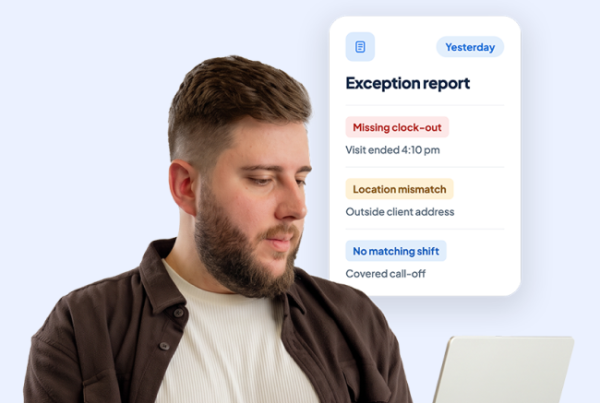
When a caregiver can’t clock in at the client’s door, the visit record breaks right then. That matters for Medicaid-funded personal care. Since January 1, 2020, those visits have needed electronic visit verification, or EVV (Medicaid.gov). EVV is an electronic record of who gave the care, where, and when. A visit without a clean record can hold up the claim.
A home care answering service can write down the problem. Fixing it means helping the caregiver with her app that same day. If that doesn’t work, someone notes the exact times so your office can approve a correction. We wrote about what one missed clock-out can cost an agency. Our morning EVV check helps keep the list of problems short.
Answering service or remote team member: how to choose
A home care answering service is a good fit for plenty of agencies. Some keep one even with a full office. The useful question is which calls your setup leaves for the morning.
| If this sounds like your office | What usually fits |
|---|---|
| Calls pile up at lunch and after 6 pm, and most can wait for a callback | A home care answering service may be enough |
| New families wait until morning for a callback | Someone who can do intake and book the assessment that evening |
| Call-offs reach a message line before the office opens | Someone working at that hour, with the backup list in front of them |
| Only your scheduler can see who’s available | A second person who works inside your scheduling software |
If your scheduler is the only one who can see the schedule, that’s where Teem comes in. Our home care virtual assistants are remote team members who work only for your agency. You get the same person every day, working inside your scheduling software on the hours you set, evenings included. They can take a family’s first call and book the assessment. They can also take call-offs, work the backup list, and fix visits that didn’t clock in for your office to approve.
A full-time remote team member costs your agency $11.50 an hour. Performance Tracker, our live dashboard, shows you their work as it happens and sends you a weekly recap by email. Most agencies start with one role, like intake, and add the next once it works.
Remote team members handle administrative, scheduling, and communication work. They never provide personal care or make care decisions. Anything about a client’s care goes to your caregivers and your office.
See what a remote team member covers
Intake, call-offs, and EVV fixes, handled in your software by one person who works only for your agency.
If you’re deciding between the two, look at a week of your own messages first. They’ll tell you more than any vendor page, this one included. Sort the overnight ones into new families, call-offs, and visit problems. You’ll see where your office could use another pair of hands.
Home care answering service FAQ
What does a home care answering service do?
It answers your agency’s calls when the office is busy, after hours, or on weekends. It takes messages using a script you write and sends urgent calls to whoever is on call.
Can an answering service schedule caregivers?
Most can’t. Scheduling means working inside your software, knowing which caregivers are free and what each client prefers. That usually stays with your office.
Should a home care agency answer calls after hours?
Yes, as long as the person who answers can act on the call. Families and caregivers call when something changes, and that’s often outside office hours. A message alone won’t cover an 8 am shift.
What happens to new client inquiries after hours?
If the line only takes messages, the family waits until someone calls back the next day. In the meantime, they can call another agency. By the time you reach them, they may have booked an assessment somewhere else.
Does an answering service work only for my agency?
Often not. At many answering services, the same operators take calls for many businesses. Some assign a small team to each account. A remote team member from Teem works only for your agency, and it’s the same person every day.
How much does a remote team member cost compared to an answering service?
Answering services price their plans in different ways, often by the minute. A full-time remote team member from Teem costs your agency $11.50 an hour and works inside your software.